Portrait of XWL Victor

VX-AI / XWL VICTOR

VX ONEDOC

Enterprise Knowledge Intelligence

An AI-assisted workspace for grounded enterprise knowledge retrieval and decision support.

VX-ONEDOC AT A GLANCE

Ask questions across your PDFs.

Get grounded answers with a clear trail back to source.

Upload Index Retrieve Generate Cite Inspect

Traceable

Answers remain connected to the source pages they came from.

Grounded

Unsupported questions are refused rather than presented as knowledge.

Focused V1

PDF-native and session-based, built to prove the core retrieval loop first.

Under The Hood

FAISS, OpenAI embeddings, chunked retrieval and LangChain orchestration.

01 Problem

Enterprise Knowledge Is Hard To Interrogate

Enterprise knowledge often lives across long, fragmented documents. LLMs can generate fluent answers, but knowledge work requires more than fluency: users need to understand what evidence supports an answer and inspect the underlying source.

VX-OneDoc frames Enterprise Knowledge Intelligence around a simple requirement: make enterprise knowledge easier to question while keeping generated answers connected to source evidence.
02 User / JTBD

Built For Document-Heavy Knowledge Work

The intended user is a knowledge worker operating in document-heavy environments who needs to extract, synthesize, and verify information from enterprise documents.

When I need to understand information contained across enterprise documents, help me retrieve and synthesize the relevant knowledge while preserving a clear path back to the supporting source.

  • Rapidly understand documents
  • Locate relevant evidence
  • Synthesize information
  • Identify decisions, risks, or governance requirements
  • Verify generated answers against source material
03 Product

Enterprise Knowledge Intelligence

VX-OneDoc is an Enterprise Knowledge Intelligence workspace designed around a grounded document workflow:

Upload → Index → Retrieve → Generate → Cite → Inspect

The product combines retrieval, generation, and source inspection within the same interaction loop so answers remain connected to the documents from which they were derived.

04 Product Decisions

Product Decisions

V1 was scoped around the smallest complete loop that could test an Enterprise Knowledge Intelligence workflow without pretending to be a production enterprise platform.

01

Grounding Over Unrestricted Answering

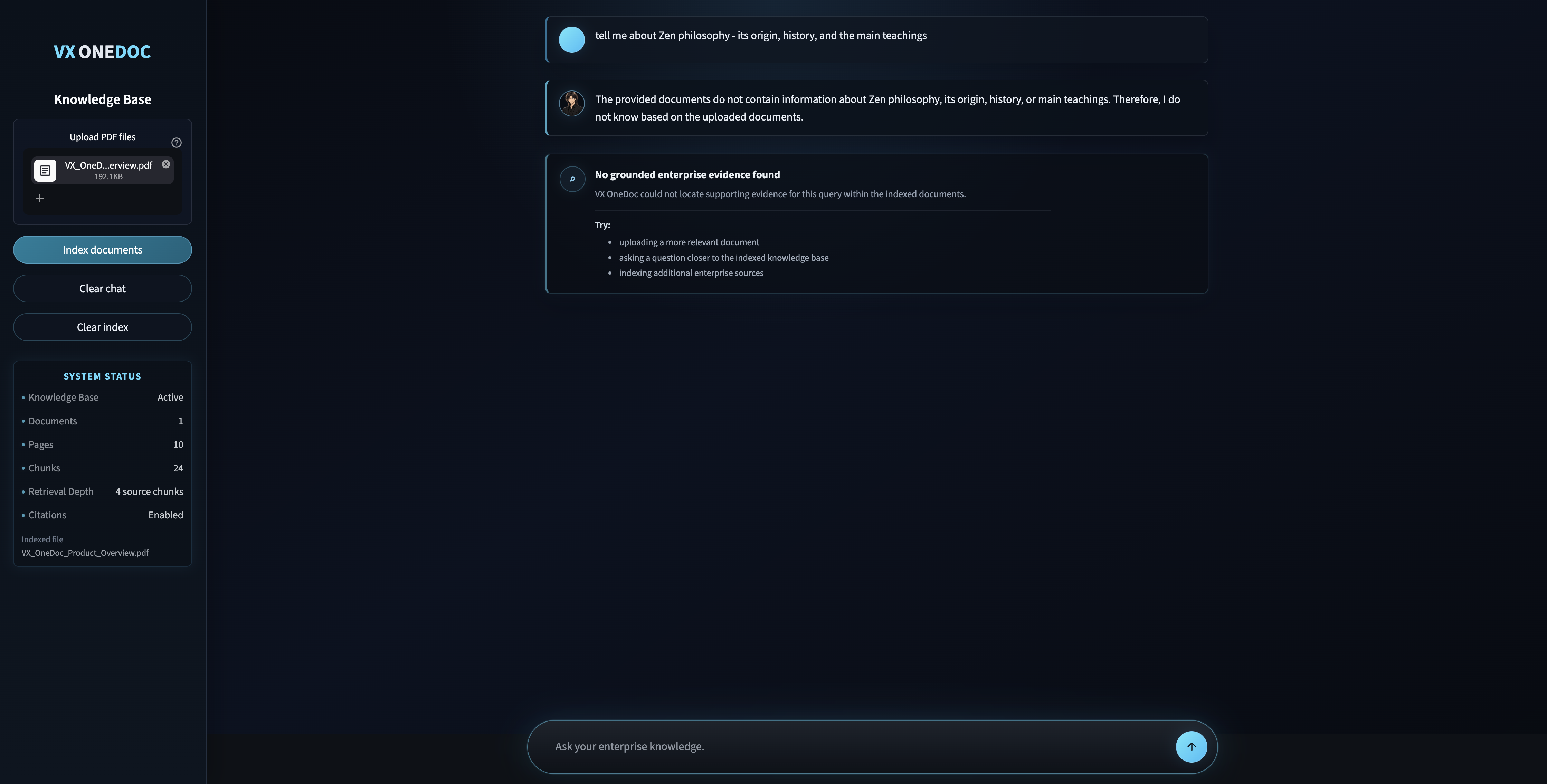
VX-OneDoc prefers an explicit insufficient-evidence state when the indexed knowledge base cannot support an answer rather than presenting unsupported information as enterprise knowledge.

02

Source Inspection As Workflow

Citations and Source Preview remain close to the generated answer so users can move from synthesis back to evidence without leaving the workflow.

03

Constrained V1 Ingestion

V1 deliberately focuses on PDF ingestion instead of broad document and enterprise-system connectivity before validating the core knowledge workflow.

04

Fast Paths For Common Knowledge Tasks

Quick actions surface common document-intelligence tasks such as executive summaries, decisions, risks, and governance requirements without requiring specialized prompts.

05

Prototype Clarity Over Premature Scale

V1 prioritizes a clear working retrieval-and-grounding loop before introducing persistent storage, access controls, connectors, and advanced retrieval systems.

05 V1 Product Spec

Condensed Product Spec

Product Thesis

Enterprise Knowledge Intelligence where generated answers remain traceable to supporting evidence.

Target User

Knowledge workers operating in document-heavy enterprise workflows.

Core JTBD

Retrieve and synthesize relevant knowledge from enterprise documents while preserving a path back to source evidence.

Trade-Off

V1 optimizes for validating the core grounded knowledge workflow rather than production-scale infrastructure or maximum retrieval sophistication.

V1 Scope

  • PDF ingestion
  • Document chunking and indexing
  • Semantic retrieval
  • Grounded answer generation
  • Inline citations
  • Source inspection / Source Preview
  • Insufficient-evidence / refusal behavior
  • Quick actions for common knowledge tasks

Out Of Scope For V1

  • Enterprise authentication / SSO
  • RBAC / document-level permissions
  • Persistent multi-user knowledge bases
  • Enterprise connectors
  • OCR-heavy document processing
  • Advanced hybrid retrieval / reranking
  • Production audit infrastructure
  • Large-scale ingestion

Proposed Success Measures

  • Retrieval relevance
  • Citation correctness / source traceability
  • Grounded-answer quality
  • Unsupported-answer / abstention behavior
  • Task completion efficiency
  • User ability to verify answers against source evidence
06 Product Walkthrough

Product Walkthrough

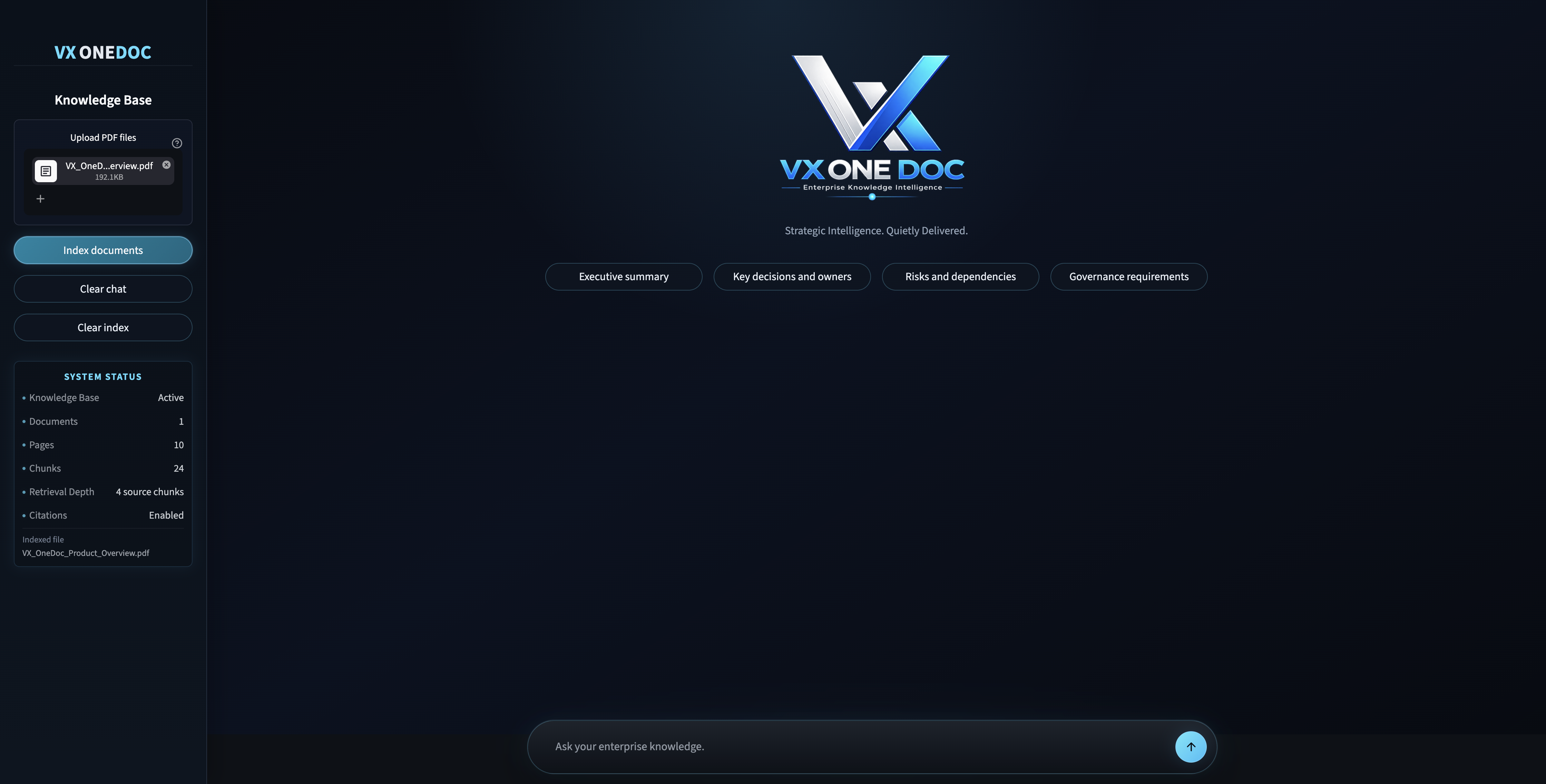
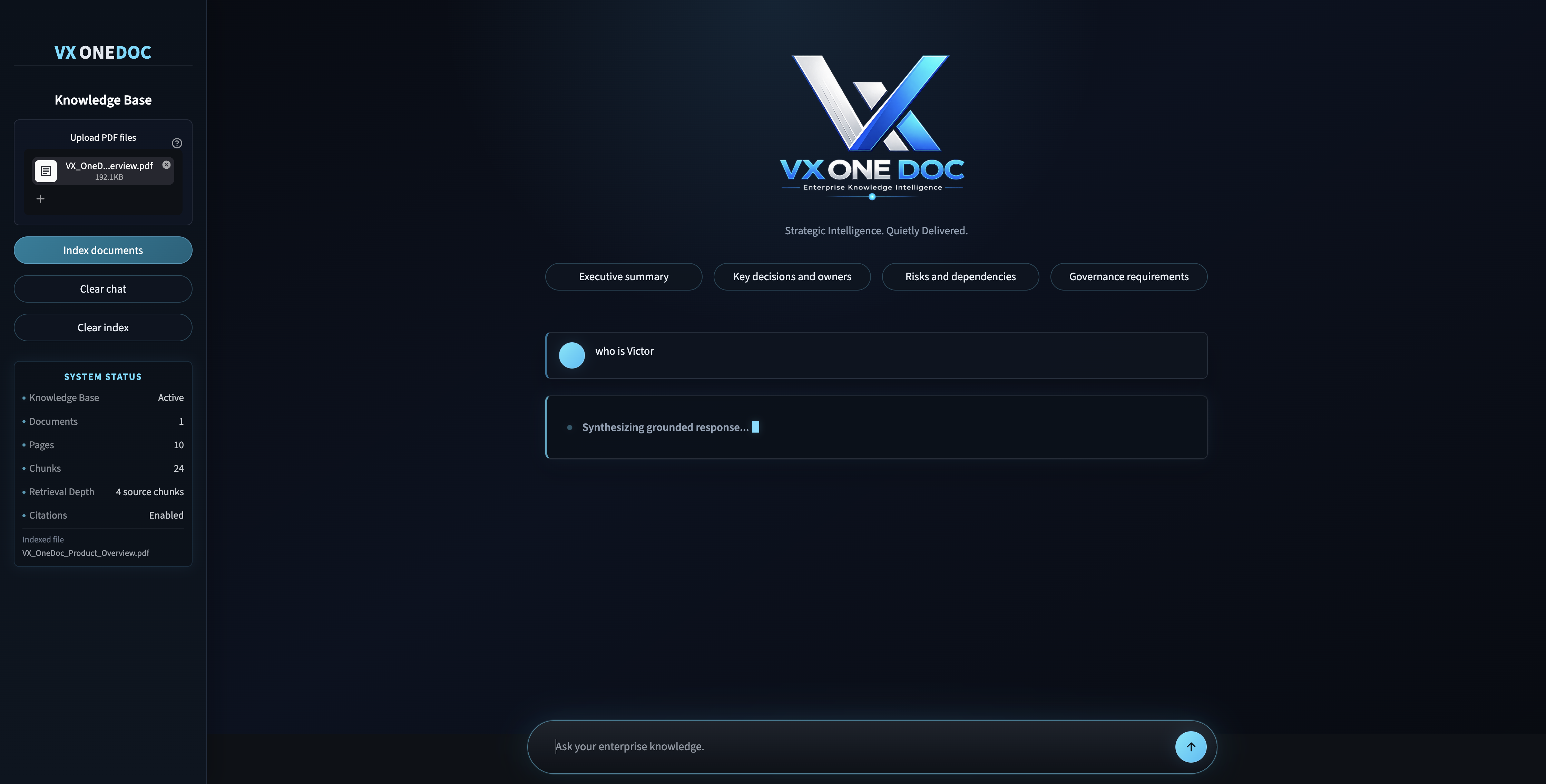
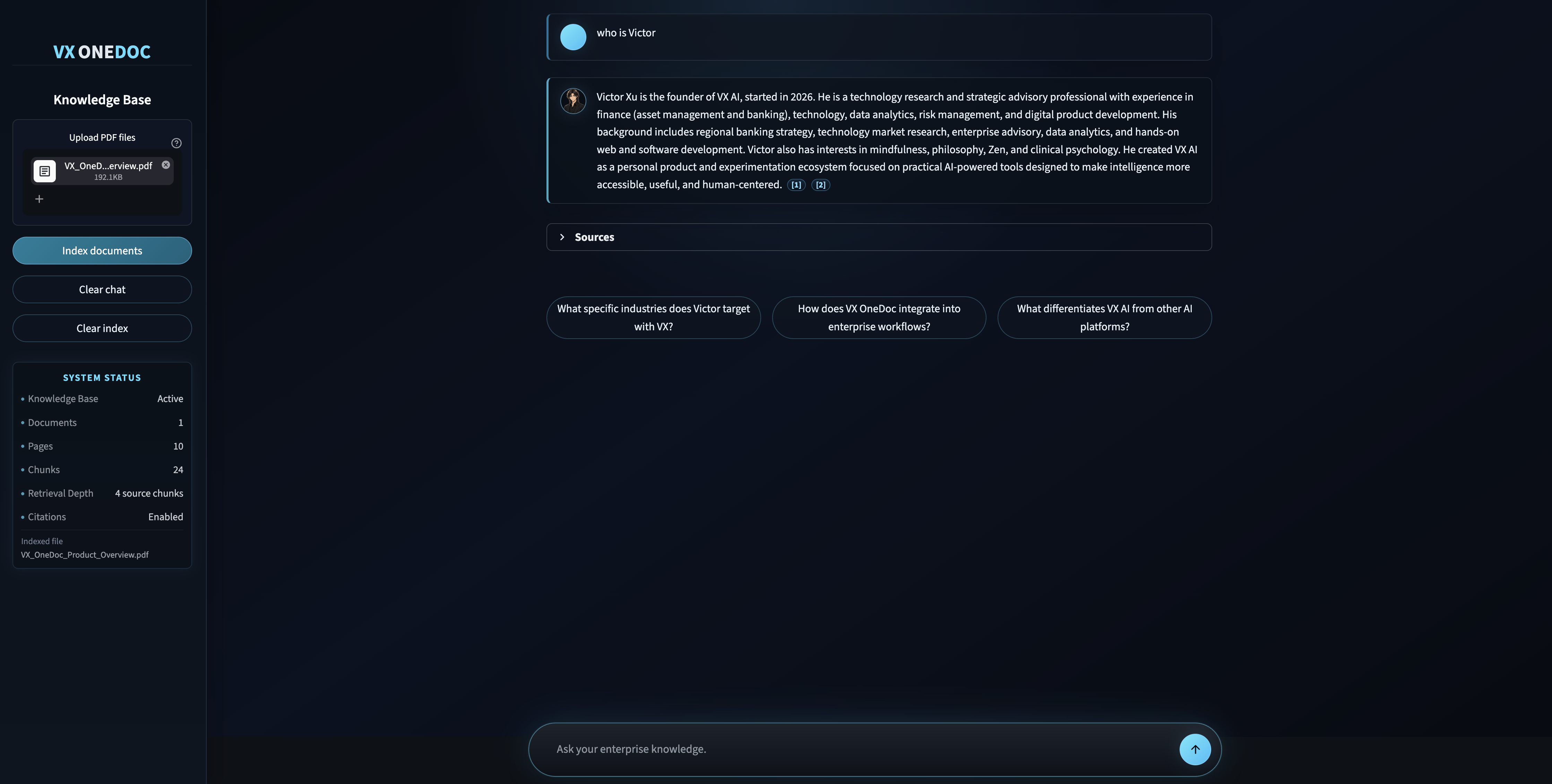
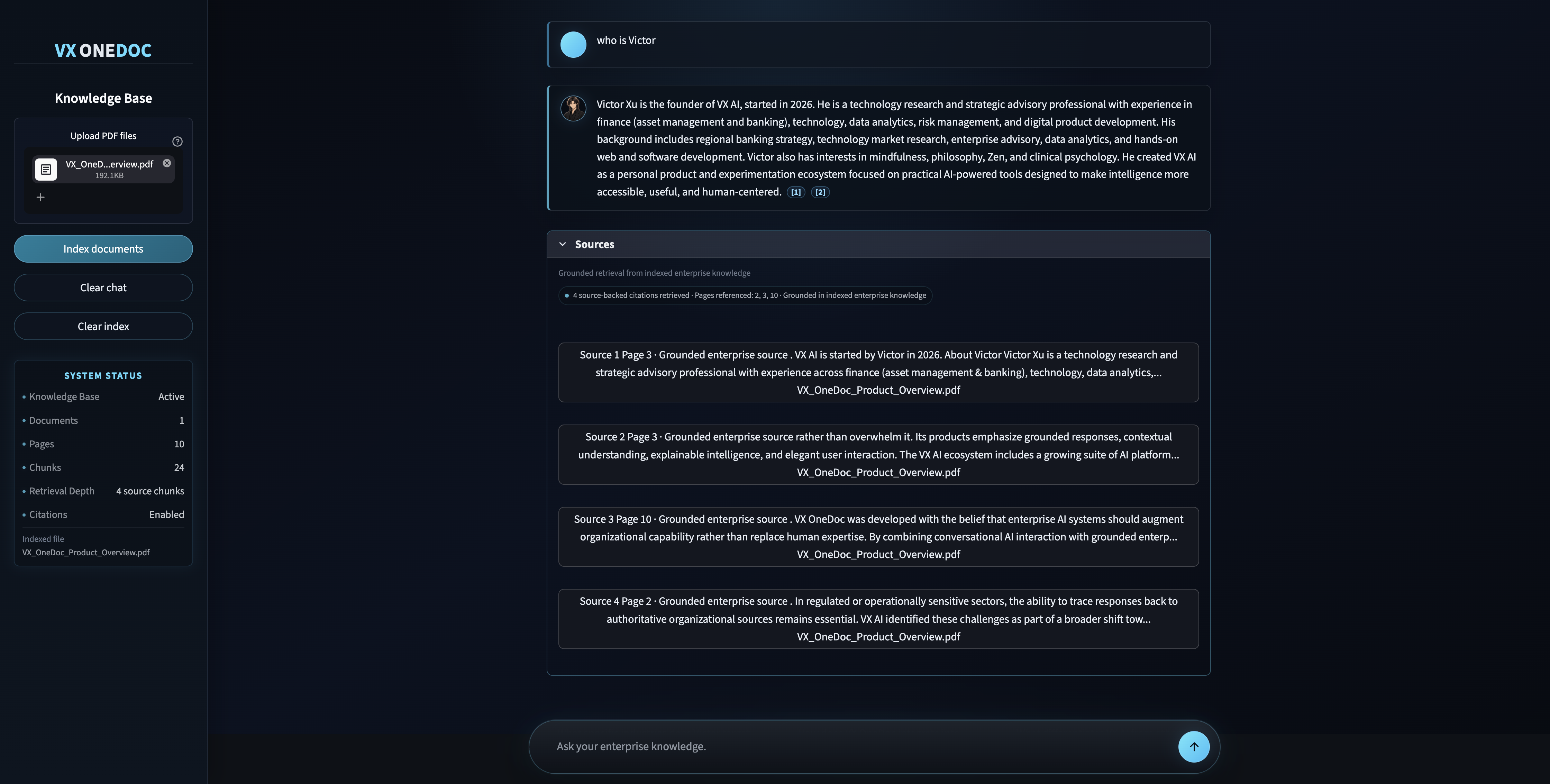
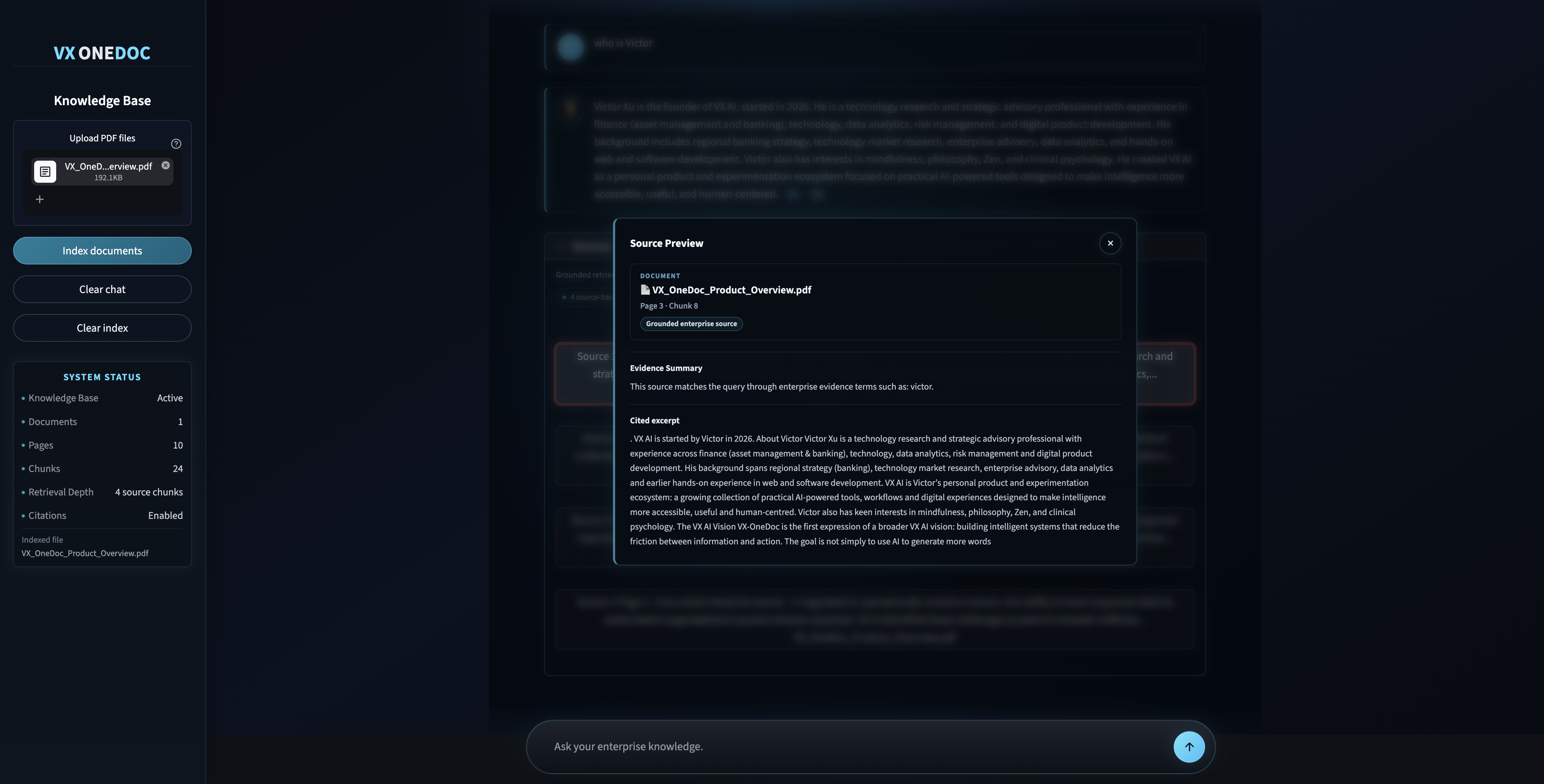
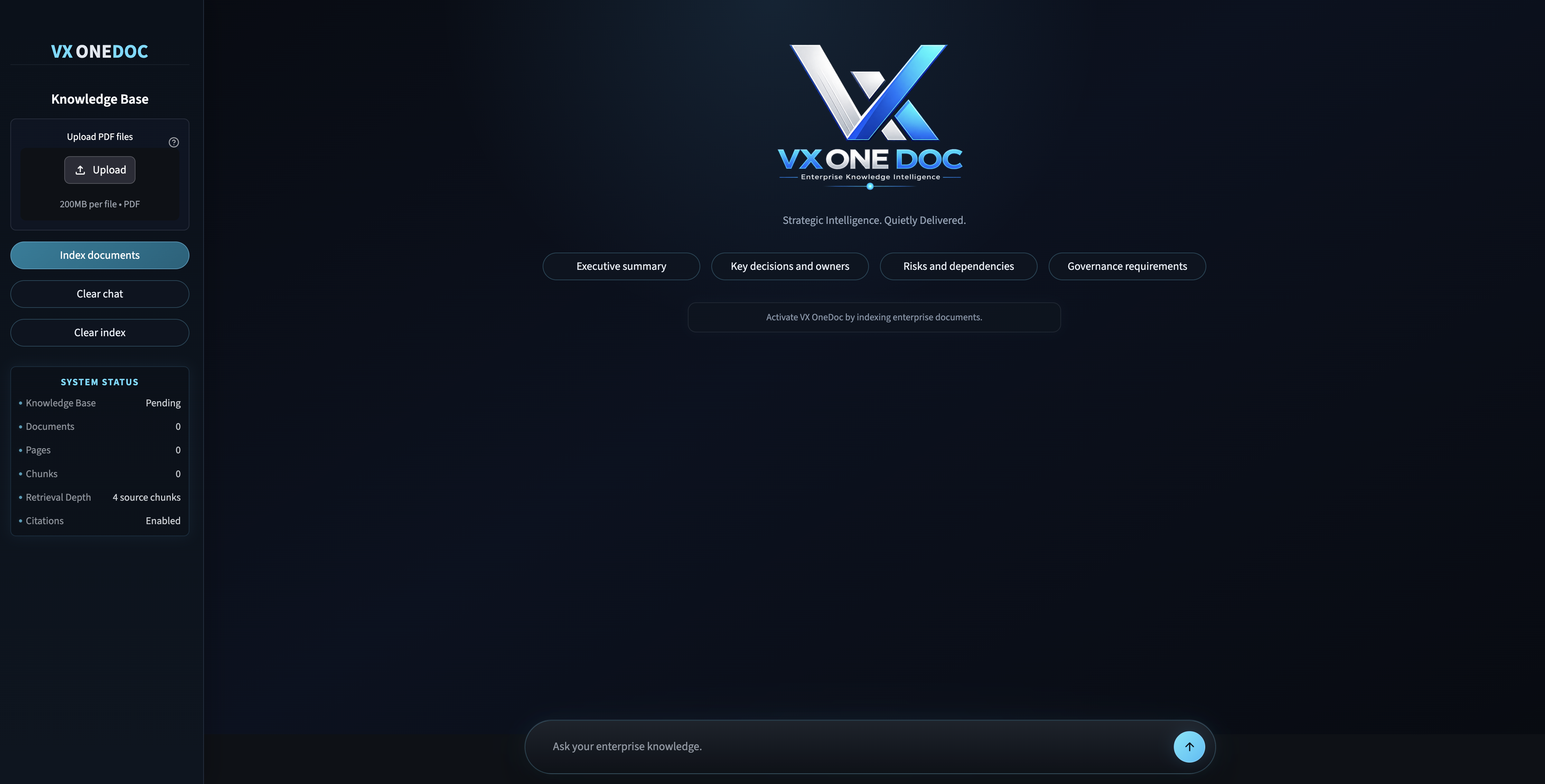
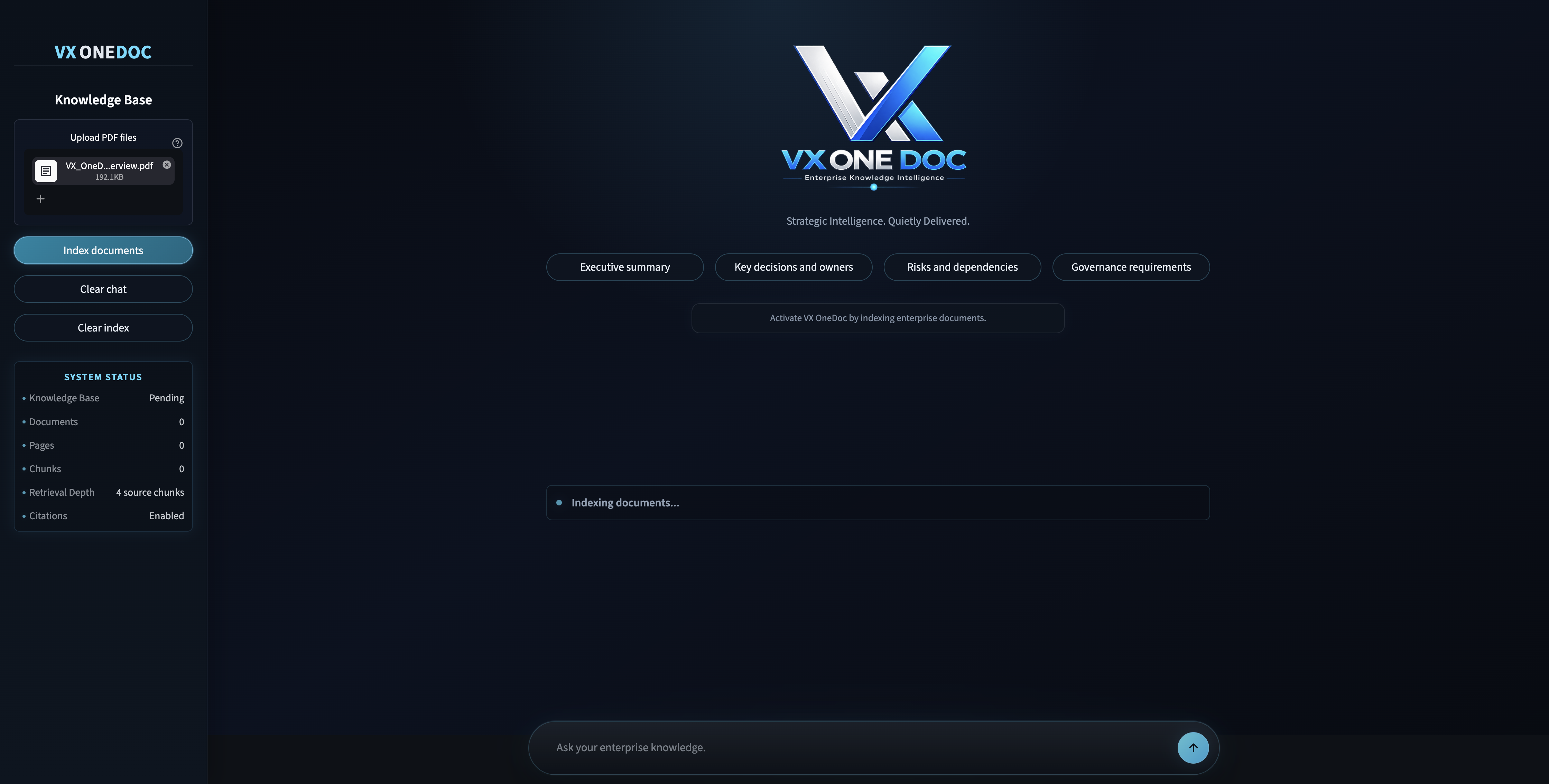
The shipped V1.0 interface demonstrates the complete product loop: upload, index, ask, retrieve, generate, cite, inspect, and refuse unsupported queries.

VX-OneDoc landing workspace with document upload, indexing, and retrieval controls
01 Workspace entry
VX-OneDoc document indexing view
02 Document indexing
VX-OneDoc active knowledge base view
03 Active knowledge base
VX-OneDoc grounded retrieval view
04 Grounded retrieval
VX-OneDoc grounded answer interface showing a question response with cited source evidence
05 Grounded answer
VX-OneDoc sources view
06 Sources
VX-OneDoc source preview interface showing retrieved source text beside the answer workspace
07 Source preview
VX-OneDoc grounded refusal view
08 Grounded refusal

FROM PRODUCT → ENGINEERING

The product decisions above define what VX-OneDoc should do. The engineering layer below explains how those decisions are implemented.

07 Engineering Decisions

Grounded intelligence

Designed for enterprise knowledge work where every answer needs a trail back to source.

VX-OneDoc keeps retrieval, reasoning, and source inspection close together so decision support remains traceable, reviewable, and anchored in the documents that matter.

Engineering Decisions

The product decisions have a concrete technical spine: a focused RAG pipeline that keeps retrieval, answer generation, and source evidence inspectable.

Implemented Today

Python, Streamlit, OpenAI GPT, OpenAI Embeddings, FAISS, LangChain, and PyPDF. The current vector index is session-based and in-memory.

PDF Documents → Chunking → Embeddings → FAISS Vector Store → Retriever → OpenAI LLM → Grounded Response → Source Preview

Technical Implementation

Uploaded PDFs are extracted page by page and split into 1,000-character chunks with 150-character overlap. Each chunk retains source, page, and chunk metadata before being embedded with OpenAI embeddings and indexed in FAISS for semantic retrieval.

Retrieved chunks are passed into the answer flow and remain available for inline citations, source cards, and Source Preview inspection. When the model indicates the answer is not available in the retrieved context, the interface suppresses citations and sources rather than presenting unsupported information as grounded knowledge.

01

Retrieval Architecture

Semantic retrieval through OpenAI embeddings and FAISS keeps the prototype architecture lightweight, inspectable, and fast to iterate.

PDF → Chunks → Embeddings → FAISS → Context → LLM → Evidence

02

Source Transparency

Source, page, and chunk metadata travel through the retrieval pipeline so retrieved evidence remains inspectable from the answer interface.

03

Retrieval Confidence

The current prototype uses prompt-guided abstention rather than calibrated confidence thresholds, an explicit boundary of the present implementation.

04

Document Chunking

PDFs are recursively divided into 1,000-character chunks with 150-character overlap to balance local context with retrieval precision.

1,000 chars / 150 overlap

08 Production Evolution

Production Evolution

V1 proves the grounded interaction loop. Production evolution focuses on persistent infrastructure, identity and access, richer ingestion, retrieval quality, verified citations, evaluation, and observability.

  • Persistent retrieval / knowledge stores
  • Identity, permissions, and access control
  • Richer document ingestion
  • Retrieval quality, hybrid search, and reranking
  • Verified citation quality and evaluation
  • Observability and production operations